
At Unity, we believe everyone deserves to feel safe, secure and supported in their home and neighbourhood. We are committed to working with residents, local authorities, the police and community partners to tackle antisocial behaviour, prevent crime and promote safer, stronger communities.
Our Team works with residents to address issues such as nuisance behaviour, harassment, domestic abuse, hate incidents, tenancy breaches and wider neighbourhood concerns. We take reports seriously, provide advice and support, and work with partner agencies to find practical solutions that help protect residents and improve quality of life.
We encourage residents to report concerns as early as possible so that we can offer the right support and take appropriate action. Together, we can create neighbourhoods where people feel safe, respected and proud to live.
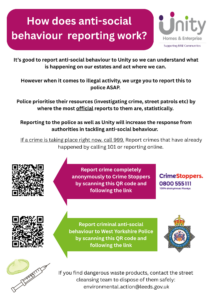
If you are experiencing an emergency or a crime is in progress, please contact the emergency services immediately by calling 999.
For community safety concerns, please contact us.
Guidance around community safety
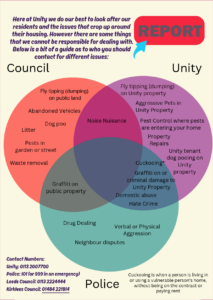
Examples of antisocial behaviour
- Persistent loud music, shouting, arguments, or other excessive noise
- Verbal abuse, threats, harassment, or intimidation
- Hate incidents or discriminatory behaviour
- Vandalism, graffiti, or damage to property
- Drug use, drug dealing, or other criminal activity
- Fly-tipping, littering, or environmental nuisance
- Public drunkenness and disorderly behaviour
- Nuisance from pets, such as excessive barking
- Unauthorised use of communal areas that causes disturbance
- Repeated neighbour disputes that escalate into harassment or intimidation
What is usually not considered antisocial behaviour?
Not every annoyance is ASB. Examples that may not normally be treated as antisocial behaviour include:
- Children playing
- Occasional household noise
- One-off parties or barbecues
- Infrequent dog barking
- Noise from normal domestic activities such as vacuuming or washing machines
- Minor disagreements between neighbours that have not escalated
Keeping Communal Areas Safe
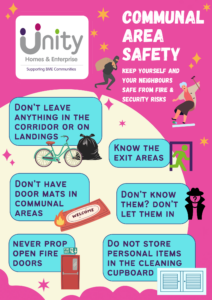
Communal areas such as entrances, stairwells, corridors, landings, lifts, bin stores, and shared gardens are for everyone’s use and enjoyment. Residents can help keep these spaces safe by:
- Keeping walkways, corridors, and fire exits clear at all times.
- Not storing personal belongings, furniture, bikes, prams, or mobility equipment in communal areas unless designated storage is provided.
- Disposing of rubbish responsibly and using bin stores correctly.
- Ensuring communal doors and security entrances are kept closed and not propped open.
- Reporting damaged lighting, broken doors, graffiti, fly-tipping, or other safety concerns as soon as possible.
- Being considerate of neighbours by avoiding excessive noise in shared areas.
- Challenging unknown visitors only if it is safe to do so, and reporting suspicious behaviour.
Keeping communal areas clear and secure helps prevent accidents, reduces fire risks, and ensures emergency services can gain access when needed. By working together, we can maintain clean, safe, and welcoming neighbourhoods for everyone.
Domestic Abuse
Domestic abuse can affect anyone, regardless of age, gender, ethnicity, disability, sexual orientation, or background. It is any pattern of controlling, coercive, threatening, violent, or abusive behaviour between people who are, or have been, intimate partners or family members.
Domestic abuse can take many forms, including:
- Physical violence or threats of violence
- Emotional or psychological abuse
- Controlling or coercive behaviour
- Financial abuse
- Sexual abuse
- Stalking or harassment
- Online or digital abuse
We are committed to supporting residents affected by domestic abuse. If you are experiencing abuse, we will listen, treat your concerns confidentially, and work with specialist agencies to help you access the support you need. Your safety is our priority.
If you or someone else is in immediate danger, call 999. If it is not safe to speak, you can call 999 and press 55 when prompted to alert the police that you need help.
You can contact ANY member of staff at Unity if you are concerned about a domestic abuse situation and we will deal with it sensitively.
You can also contact the national centre for domestic violence and abuse
Text: NCDV to 60777
Cuckooing is a form of criminal exploitation where criminals take over the home of a vulnerable person and use it for illegal activities, such as dealing or storing drugs, storing weapons, or other criminal behaviour. It is commonly linked to county lines drug activity.
Criminals often target people who may be vulnerable due to age, disability, mental health needs, substance misuse, loneliness, or financial difficulties. They may initially appear friendly and offer help, gifts, money, drugs, or companionship before gradually taking control of the property. In some cases, threats, intimidation, or violence are used to maintain control.
Signs of cuckooing may include:
- An increase in visitors at unusual times of the day or night.
- People coming and going frequently from a property.
- Signs of drug use, antisocial behaviour, or criminal activity.
- The resident appearing withdrawn, frightened, or unable to control who enters their home.
- Damage to the property or concerns from neighbours about activity at the address.
If you are concerned that someone may be a victim of cuckooing, report it to your Unity, the police, or local safeguarding services. Early intervention can help protect vulnerable residents and prevent exploitation.
Safeguarding Children and Adults
We are committed to helping keep our residents safe. If you are worried that a child or adult is experiencing abuse, neglect, exploitation, domestic abuse, or any form of harm, please report your concerns as soon as possible. Early action can help protect vulnerable people and prevent further harm.
If the person is in immediate danger, call 999. [leeds.gov.uk], [leedsscp.org.uk]
For non-emergency safeguarding concerns:
- Leeds residents can contact Leeds City Council Adult Social Care or the Leeds Safeguarding Children Partnership. [leeds.gov.uk], [leedsscp.org.uk]
- Kirklees residents can contact Kirklees Adult Social Care or children’s social care services. [kirklees.gov.uk], [rfkirklees…ent.org.uk]
If you are unsure whether something is a safeguarding concern, it is always better to report it and seek advice.